
How Time Zone Variations Affect Player Pool Composition in International Texas Hold'em Tournaments
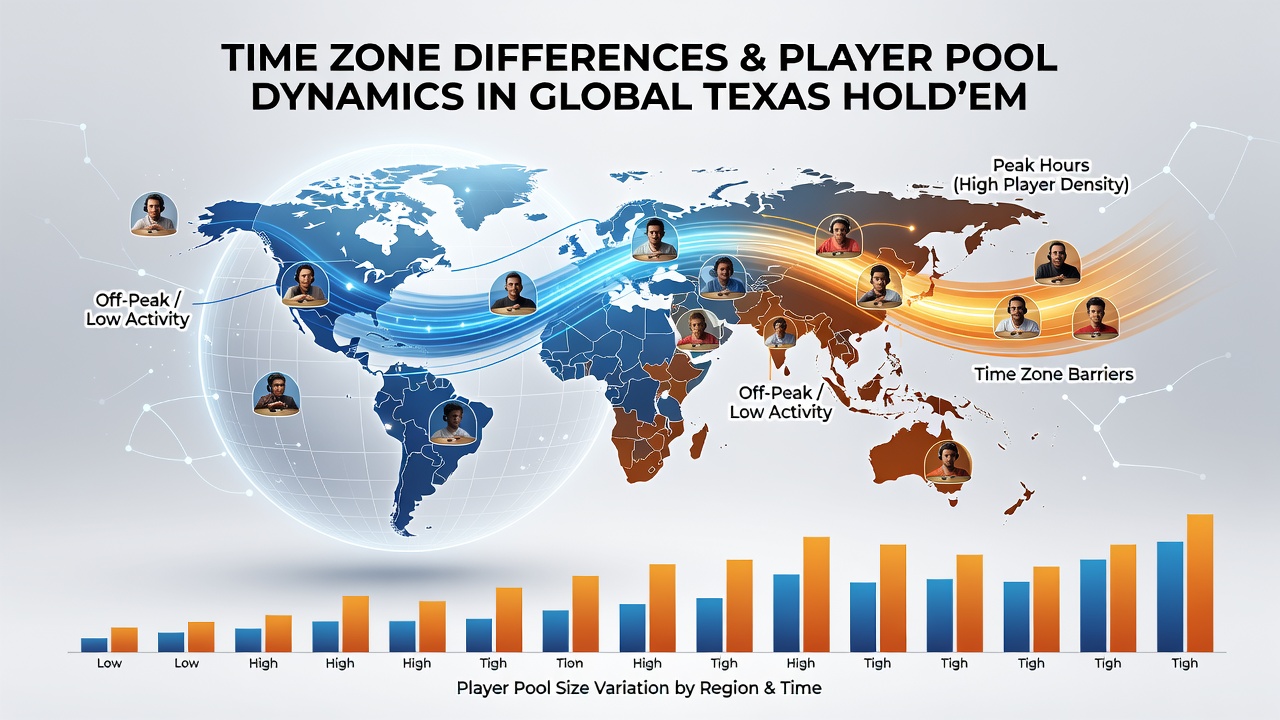
Global Texas Hold'em competitions draw participants from dozens of time zones simultaneously, and this geographic spread creates distinct shifts in who sits at virtual tables during any given hour, with data from major platforms showing that European players often fill early morning slots for North American users while Asian competitors dominate late evening sessions in the same regions.
Mapping Participation Across Continents
Operators track login patterns through server logs that record entry times in UTC, and those records reveal consistent clusters where players from similar longitudes log in together because their local clocks align with standard tournament start times, whereas cross-zone participants join in smaller numbers when the hour falls outside typical work or sleep schedules.
Researchers at institutions studying digital gaming behavior have documented that Australian and New Zealand entrants increase their activity during what is nighttime for much of Europe, and this rotation changes the average stack sizes and hand volumes recorded at those tables, according to aggregated platform statistics released in industry reports.
Peak Hours and Regional Density
When a major event begins at 20:00 UTC, players from the UK and Western Europe represent the largest single cohort because the start time coincides with evening leisure hours, yet the same schedule places East Coast North American users in late afternoon, which produces a measurable drop in overall volume until later waves open for Pacific participants.
Observers note that November 2026 schedules for several flagship series already list staggered starting times precisely to balance these inflows, and preliminary registration data indicate higher diversity scores when start times rotate across at least four primary zones rather than remaining fixed to a single UTC anchor.
Effects on Table Dynamics
Player pool composition influences average aggression metrics because regional styles documented in hand-history databases tend to cluster by time of day, with Asian participants showing elevated three-bet frequencies during their local prime hours while European cohorts record steadier pre-flop fold rates during overlapping windows, and these patterns appear in multiple seasons of tracked data without requiring subjective interpretation.
Platforms that publish hourly participation breakdowns demonstrate that tables running between 02:00 and 06:00 UTC consistently feature higher percentages of North American recreational users, whereas tables between 12:00 and 16:00 UTC skew toward Southeast Asian professionals, and this alternation affects the speed at which pots reach showdown.
Data Sources and Measurement Approaches
Analysts rely on anonymized timestamp exports from tournament software to calculate regional representation, and cross-referencing these exports with public IP geolocation databases allows researchers to quantify how a four-hour shift in start time can increase one continent's share by double-digit percentages while decreasing another's proportionally.
Reports compiled by the European Gaming and Betting Association have examined multi-zone events and found that synchronized satellite qualifiers drawn from different longitudes produce final tables whose geographic makeup more closely mirrors the overall registered population than single-zone qualifiers do.
Additional findings from Canadian regulatory summaries indicate that operators offering rolling start times across a 24-hour window record steadier total entry counts because players in distant zones encounter at least one convenient window each day, and this consistency appears in monthly aggregates released by provincial oversight bodies.
Strategic Adjustments Observed in Practice
Those who review historical hand data across repeated events note that participants often adjust opening ranges when facing pools known to originate from specific time windows, yet these adjustments remain based on observable frequency statistics rather than assumptions about individual opponents, and platform tools now surface zone-based cohort statistics to support such analysis.
Case examples drawn from 2025 series show that events with start times deliberately offset by six hours attracted a broader spread of Asian and American entrants on the same day, and registration curves published by organizers illustrate the resulting lift in cumulative entries without any change to prize structures.
Conclusion
Time zone alignment therefore functions as an invisible scheduler that determines which regional cohorts dominate each segment of the tournament calendar, and continued collection of UTC-stamped participation data will allow organizers and analysts to refine scheduling further as global player bases continue to expand.